
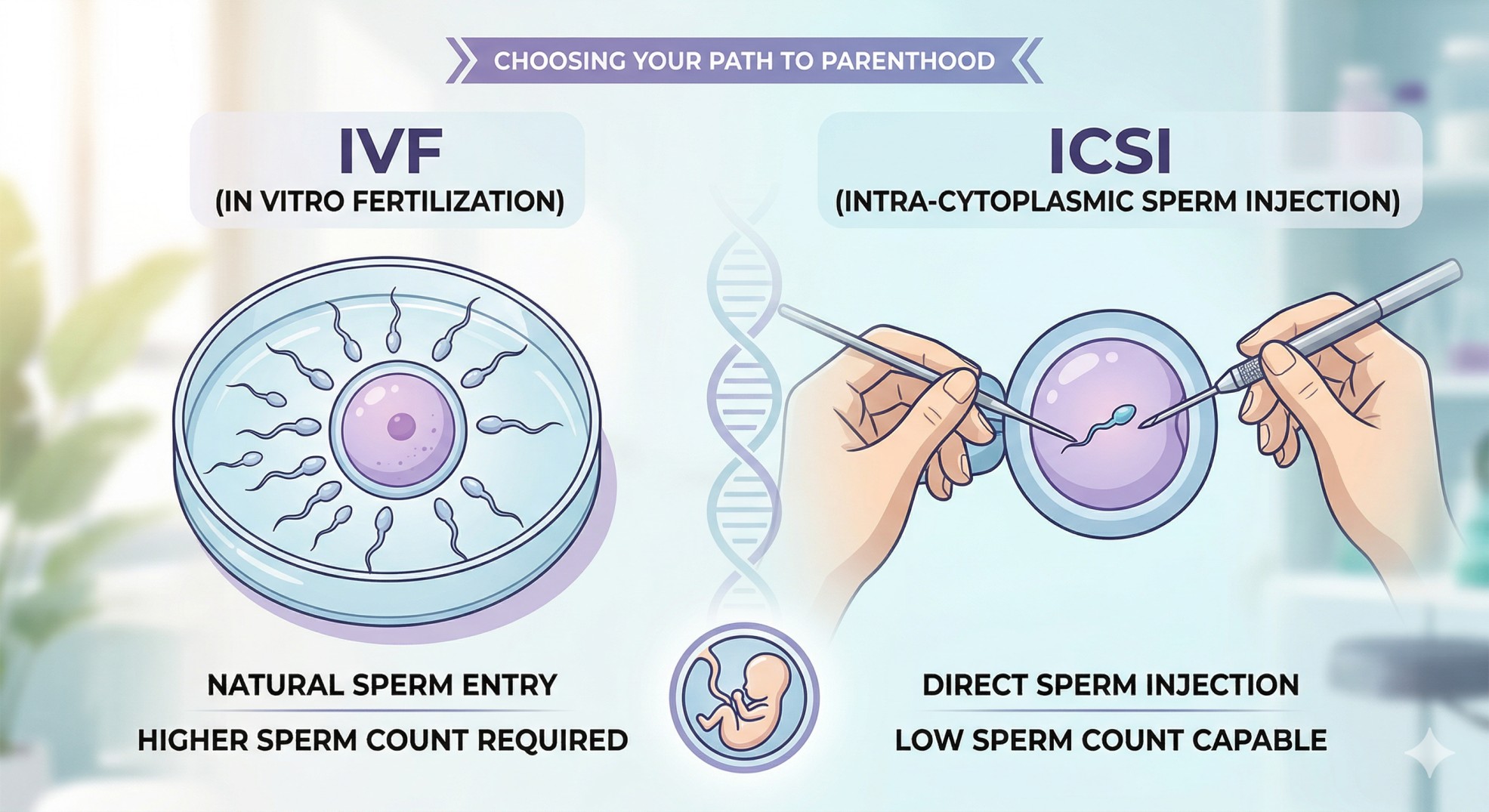
Determining the right path for a fertility journey is a deeply personal process. While both IVF (In Vitro Fertilization) and ICSI (Intracytoplasmic Sperm Injection) are advanced reproductive technologies used to help couples conceive, they differ significantly in how fertilization occurs in the lab.
Here is a breakdown of the differences, the procedures, and which might be the right choice for specific circumstances.
1. What is IVF? (The Traditional Method)
In traditional IVF, fertilization happens through a “natural selection” process within a laboratory dish. After the eggs are retrieved from the ovaries, they are placed in a culture dish with thousands of prepared sperm cells.
-
The Process: The sperm must swim to the egg and penetrate the outer shell (the zona pellucida) on its own.
-
The Goal: To allow the healthiest sperm to fertilize the egg independently, mimicking the natural process as closely as possible in a controlled environment.
2. What is ICSI? (The Targeted Method)
ICSI is a specialized form of IVF. Instead of letting the sperm swim to the egg, a highly skilled embryologist selects a single, healthy-looking sperm and injects it directly into the center of the mature egg using a microscopic needle.
-
The Process: The “swim and penetrate” step is bypassed. The embryologist ensures the sperm enters the egg.
-
The Goal: To maximize the chances of fertilization when there are issues with sperm quality, quantity, or previous fertilization failures.
Key Differences at a Glance
| Feature | Traditional IVF | ICSI |
| Sperm Requirement | High (approx. 50,000+ motile sperm) | Minimal (1 healthy sperm per egg) |
| Fertilization Method | Natural penetration in a dish | Manual injection by an embryologist |
| Main Use Case | Tubal issues, unexplained infertility | Male factor infertility |
| Selection Process | Natural selection by the sperm | Visual selection by the embryologist |
When is ICSI Recommended?
While ICSI is often performed alongside IVF, it is specifically recommended in cases where the “natural” fertilization in a dish is unlikely to succeed. This includes:
-
Low Sperm Count: When there aren’t enough sperm to effectively surround the egg.
-
Poor Motility: If the sperm are not swimming well enough to reach or penetrate the egg.
-
Abnormal Morphology: If the sperm have shapes that make it difficult to break through the egg’s outer layer.
-
Previous IVF Failure: If a previous cycle of traditional IVF resulted in few or no fertilized eggs.
-
Surgically Retrieved Sperm: If sperm must be collected via a procedure (like TESE) due to a blockage.
The Common Ground: The Procedure
Aside from the specific moment of fertilization, the steps for the patient remain virtually identical for both IVF and ICSI:
-
Ovarian Stimulation: The patient takes hormone medications to produce multiple eggs.
-
Egg Retrieval: A minor surgical procedure to collect the mature eggs.
-
Sperm Collection: A sample is provided by the partner or a donor.
-
Fertilization: This is where the paths diverge (Traditional vs. ICSI).
-
Embryo Culture: The resulting embryos are monitored in the lab for 3 to 5 days.
-
Embryo Transfer: One or more healthy embryos are transferred into the uterus.
Success Rates and Considerations
Success rates for both procedures are generally comparable, as the primary factor is often the quality of the eggs and embryos rather than the fertilization method itself. However, ICSI provides a significantly higher fertilization rate in cases of male-factor infertility.
Important Note: ICSI does involve a slightly higher cost due to the specialized equipment and labor required. Additionally, while rare, there is a very small risk of damage to the egg during the injection process (roughly less than 5%).
